
Overview
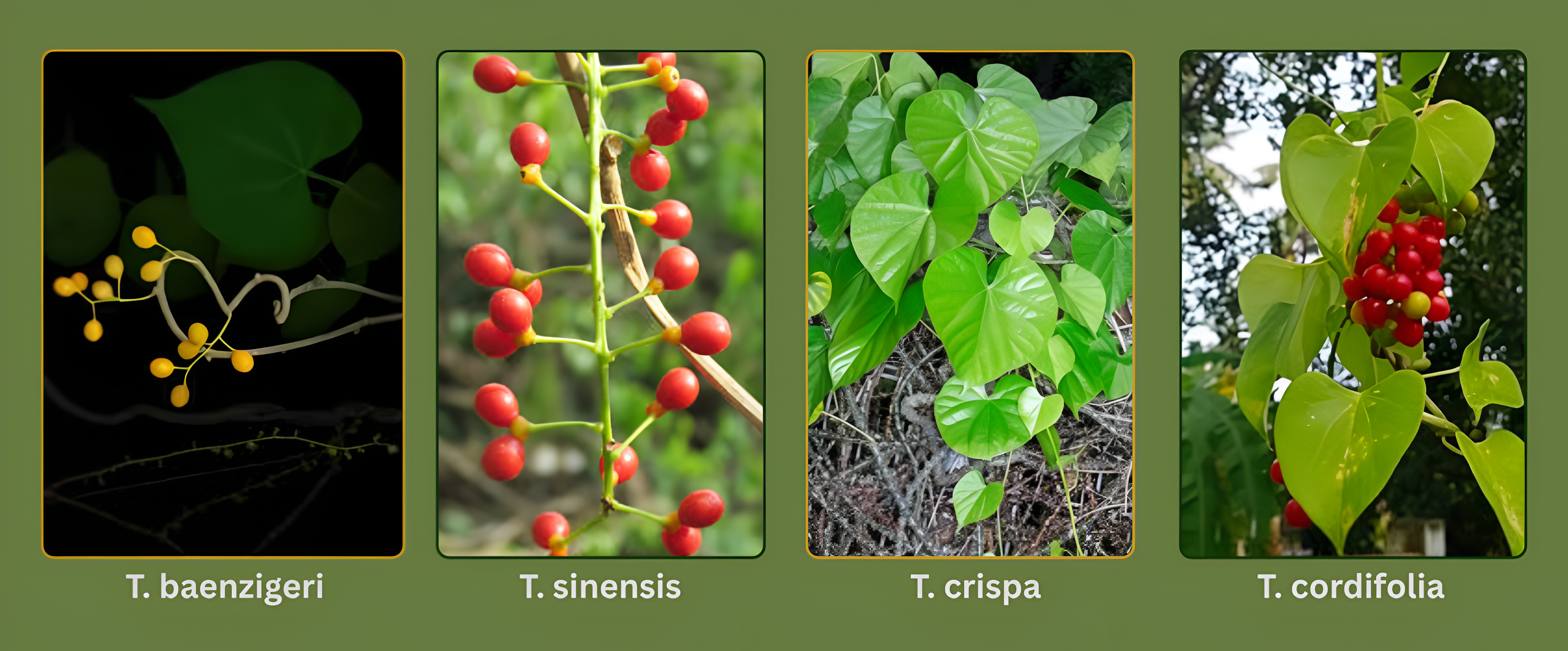
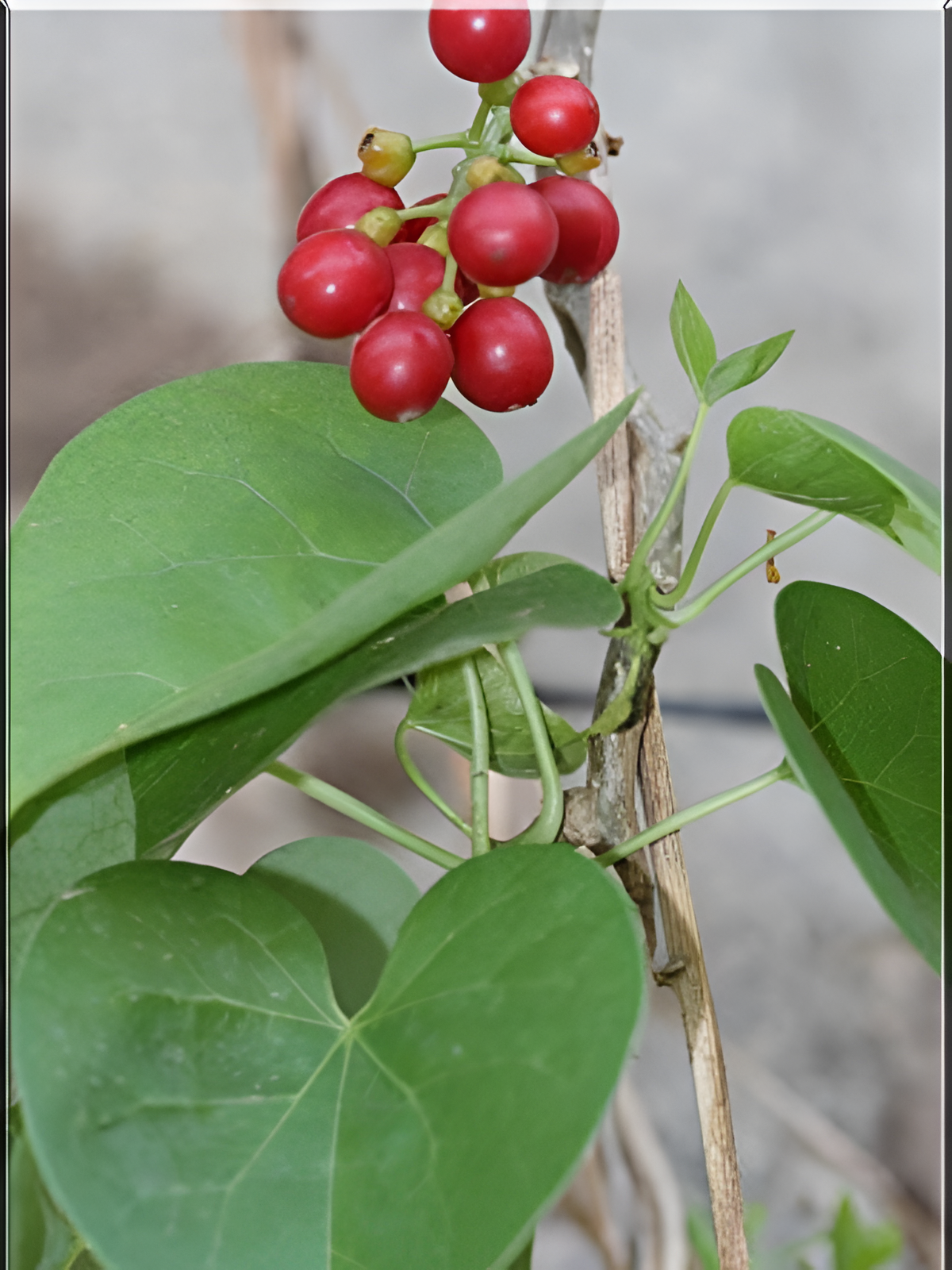
This project investigates the phylogenetic relationships among six species, including Tinospora spp., Paratinospora sagittata, and Menispermum dauricum, using chloroplast rbcL gene sequences sourced from GenBank. These species, belonging to the family Menispermaceae, are of medicinal and ecological importance. The analysis aims to clarify evolutionary divergence and relatedness using amino acid-based phylogenetic inference methods.
Objectives
- Retrieve and curate rbcL chloroplast sequences from GenBank for six target taxa.
- Perform multiple sequence alignment and cleaning to ensure comparability.
- Construct phylogenetic trees using Maximum Likelihood (ML) and Neighbor-Joining (NJ) methods.
- Interpret clade formation and divergence levels in relation to taxonomic relationships.
Targeted Species
| Species | Accession # | Gene |
|---|---|---|
| Tinospora cordifolia | MT834944.1 | rbcL |
| Tinospora sinensis | PV747743.1 | rbcL |
| Tinospora crispa | LC744922.1 | rbcL |
| Tinospora baenzigeri | KY365708.1 | rbcL |
| Paratinospora sagittata | OQ579165.1 | rbcL |
| Menispermum dauricum | OP271868.1 | rbcL |
Methods & Tools
- Sequence Retrieval: Downloaded rbcL sequences from GenBank and verified via BLASTn.
- Multiple Sequence Alignment: Performed using MEGA12’s ClustalW module.
- Model Selection: For ML, the Jones-Taylor-Thornton (JTT) model was selected; for NJ, the Poisson correction method was used.
- Tree Construction: Generated ML and NJ phylogenies with 1,000 bootstrap replicates.
- Interpretation: Bootstrap support values used to assess clade reliability.
Results
- T. cordifolia and T. sinensis clustered together with 99% bootstrap support.
- T. crispa grouped with T. baenzigeri at 90% support.
- Paratinospora sagittata formed a sister group to the Tinospora clade.
- Menispermum dauricum diverged earliest among the taxa studied.
Phylogenetic Analysis
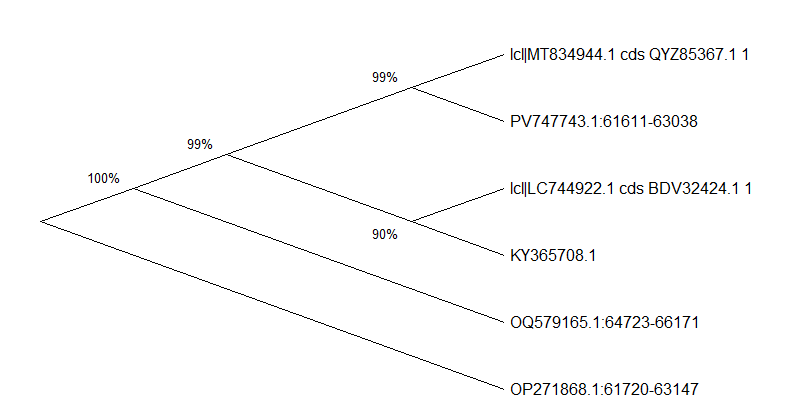
Caption: Evolutionary analysis by the Maximum Likelihood method.
The phylogeny was inferred using the Maximum Likelihood method and Jones-Taylor-Thornton (1992) model [1] of amino acid substitutions and the tree with the highest log likelihood (-4,626.27) is shown. The initial tree for the heuristic search was selected by choosing the tree with the superior log-likelihood between a Neighbor-Joining (NJ) tree [2] and a Maximum Parsimony (MP) tree. The NJ tree was generated using a matrix of pairwise distances computed using the Jones-Taylor-Thornton (1992) model [1]. The MP tree had the shortest length among 10 MP tree searches, each performed with a randomly generated starting tree. The proportion of sites where at least 1 unambiguous base is present in at least 1 sequence for each descendent clade is shown next to each internal node in the tree. The analytical procedure encompassed 6 amino acid sequences with 1,449 positions in the final dataset. Evolutionary analyses were conducted in MEGA12 [3].
1. Jones D.T., Taylor W.R., and Thornton J.M. (1992). The rapid generation of mutation data matrices from protein sequences. Computer Applications in the Biosciences 8: 275-282.
2. Saitou N. and Nei M. (1987). The neighbor-joining method: A new method for reconstructing phylogenetic trees. Molecular Biology and Evolution 4:406-425.
3. Kumar S., Stecher G., Suleski M., Sanderford M., Sharma S., and Tamura K. (2024). Molecular Evolutionary Genetics Analysis Version 12 for adaptive and green computing. Molecular Biology and Evolution 41:1-9.
Disclaimer: While every effort has been made to ensure the accuracy of the caption, it is provided "as is" without warranty of any kind. Users are advised to thoroughly review the caption before its use for any purpose and report any errors or issues to the authors at www.megasoftware.net. The authors and their employers disclaim any liability for damages, including but not limited to special or consequential damages. Additionally, the authors expressly disclaim all other warranties, whether expressed or implied, including the suitability of the caption text for a specific purpose, use, or application.
The phylogeny was inferred using the Maximum Likelihood method and Jones-Taylor-Thornton (1992) model [1] of amino acid substitutions and the tree with the highest log likelihood (-4,626.27) is shown. The initial tree for the heuristic search was selected by choosing the tree with the superior log-likelihood between a Neighbor-Joining (NJ) tree [2] and a Maximum Parsimony (MP) tree. The NJ tree was generated using a matrix of pairwise distances computed using the Jones-Taylor-Thornton (1992) model [1]. The MP tree had the shortest length among 10 MP tree searches, each performed with a randomly generated starting tree. The proportion of sites where at least 1 unambiguous base is present in at least 1 sequence for each descendent clade is shown next to each internal node in the tree. The analytical procedure encompassed 6 amino acid sequences with 1,449 positions in the final dataset. Evolutionary analyses were conducted in MEGA12 [3].
1. Jones D.T., Taylor W.R., and Thornton J.M. (1992). The rapid generation of mutation data matrices from protein sequences. Computer Applications in the Biosciences 8: 275-282.
2. Saitou N. and Nei M. (1987). The neighbor-joining method: A new method for reconstructing phylogenetic trees. Molecular Biology and Evolution 4:406-425.
3. Kumar S., Stecher G., Suleski M., Sanderford M., Sharma S., and Tamura K. (2024). Molecular Evolutionary Genetics Analysis Version 12 for adaptive and green computing. Molecular Biology and Evolution 41:1-9.
Disclaimer: While every effort has been made to ensure the accuracy of the caption, it is provided "as is" without warranty of any kind. Users are advised to thoroughly review the caption before its use for any purpose and report any errors or issues to the authors at www.megasoftware.net. The authors and their employers disclaim any liability for damages, including but not limited to special or consequential damages. Additionally, the authors expressly disclaim all other warranties, whether expressed or implied, including the suitability of the caption text for a specific purpose, use, or application.
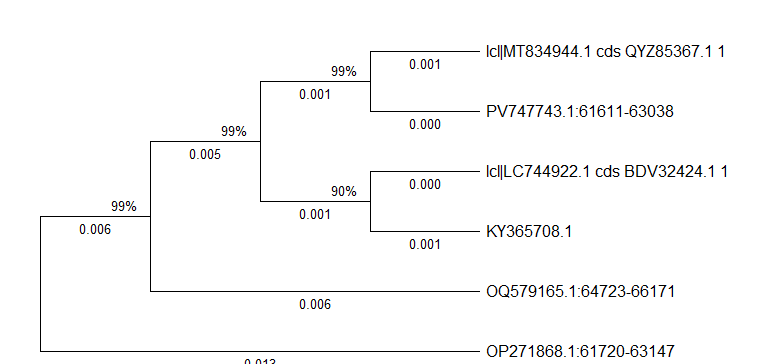
Caption: Evolutionary relationships of 6 taxa.
The evolutionary history was inferred using the Neighbor-Joining method [1]. The optimal tree with the sum of branch length = 0.033 is shown. The evolutionary distances were computed using the Poisson correction method [2] and are in the units of the number of amino acid substitutions per site. The proportion of sites where at least 1 unambiguous base is present in at least 1 sequence for each descendent clade is shown next to each internal node in the tree. The analytical procedure encompassed 6 amino acid sequences. The pairwise deletion option was applied to all ambiguous positions for each sequence pair resulting in a final data set comprising 1,449 positions. Evolutionary analyses were conducted in MEGA12 [3].
1. Saitou N. and Nei M. (1987). The neighbor-joining method: A new method for reconstructing phylogenetic trees. Molecular Biology and Evolution 4:406-425.
2. Zuckerkandl E. and Pauling L. (1965). Evolutionary divergence and convergence in proteins. Edited in Evolving Genes and Proteins by V. Bryson and H.J. Vogel, pp. 97-166. Academic Press, New York.
3. Kumar S., Stecher G., Suleski M., Sanderford M., Sharma S., and Tamura K. (2024). Molecular Evolutionary Genetics Analysis Version 12 for adaptive and green computing. Molecular Biology and Evolution 41:1-9.
Disclaimer: While every effort has been made to ensure the accuracy of the caption, it is provided "as is" without warranty of any kind. Users are advised to thoroughly review the caption before its use for any purpose and report any errors or issues to the authors at www.megasoftware.net. The authors and their employers disclaim any liability for damages, including but not limited to special or consequential damages. Additionally, the authors expressly disclaim all other warranties, whether expressed or implied, including the suitability of the caption text for a specific purpose, use, or application.
The evolutionary history was inferred using the Neighbor-Joining method [1]. The optimal tree with the sum of branch length = 0.033 is shown. The evolutionary distances were computed using the Poisson correction method [2] and are in the units of the number of amino acid substitutions per site. The proportion of sites where at least 1 unambiguous base is present in at least 1 sequence for each descendent clade is shown next to each internal node in the tree. The analytical procedure encompassed 6 amino acid sequences. The pairwise deletion option was applied to all ambiguous positions for each sequence pair resulting in a final data set comprising 1,449 positions. Evolutionary analyses were conducted in MEGA12 [3].
1. Saitou N. and Nei M. (1987). The neighbor-joining method: A new method for reconstructing phylogenetic trees. Molecular Biology and Evolution 4:406-425.
2. Zuckerkandl E. and Pauling L. (1965). Evolutionary divergence and convergence in proteins. Edited in Evolving Genes and Proteins by V. Bryson and H.J. Vogel, pp. 97-166. Academic Press, New York.
3. Kumar S., Stecher G., Suleski M., Sanderford M., Sharma S., and Tamura K. (2024). Molecular Evolutionary Genetics Analysis Version 12 for adaptive and green computing. Molecular Biology and Evolution 41:1-9.
Disclaimer: While every effort has been made to ensure the accuracy of the caption, it is provided "as is" without warranty of any kind. Users are advised to thoroughly review the caption before its use for any purpose and report any errors or issues to the authors at www.megasoftware.net. The authors and their employers disclaim any liability for damages, including but not limited to special or consequential damages. Additionally, the authors expressly disclaim all other warranties, whether expressed or implied, including the suitability of the caption text for a specific purpose, use, or application.
Applications
- Improves taxonomic clarity within Tinospora and related genera.
- Supports conservation efforts by identifying genetically distinct lineages.
- Informs medicinal plant research by linking phylogeny to bioactive compound diversity.