
Overview
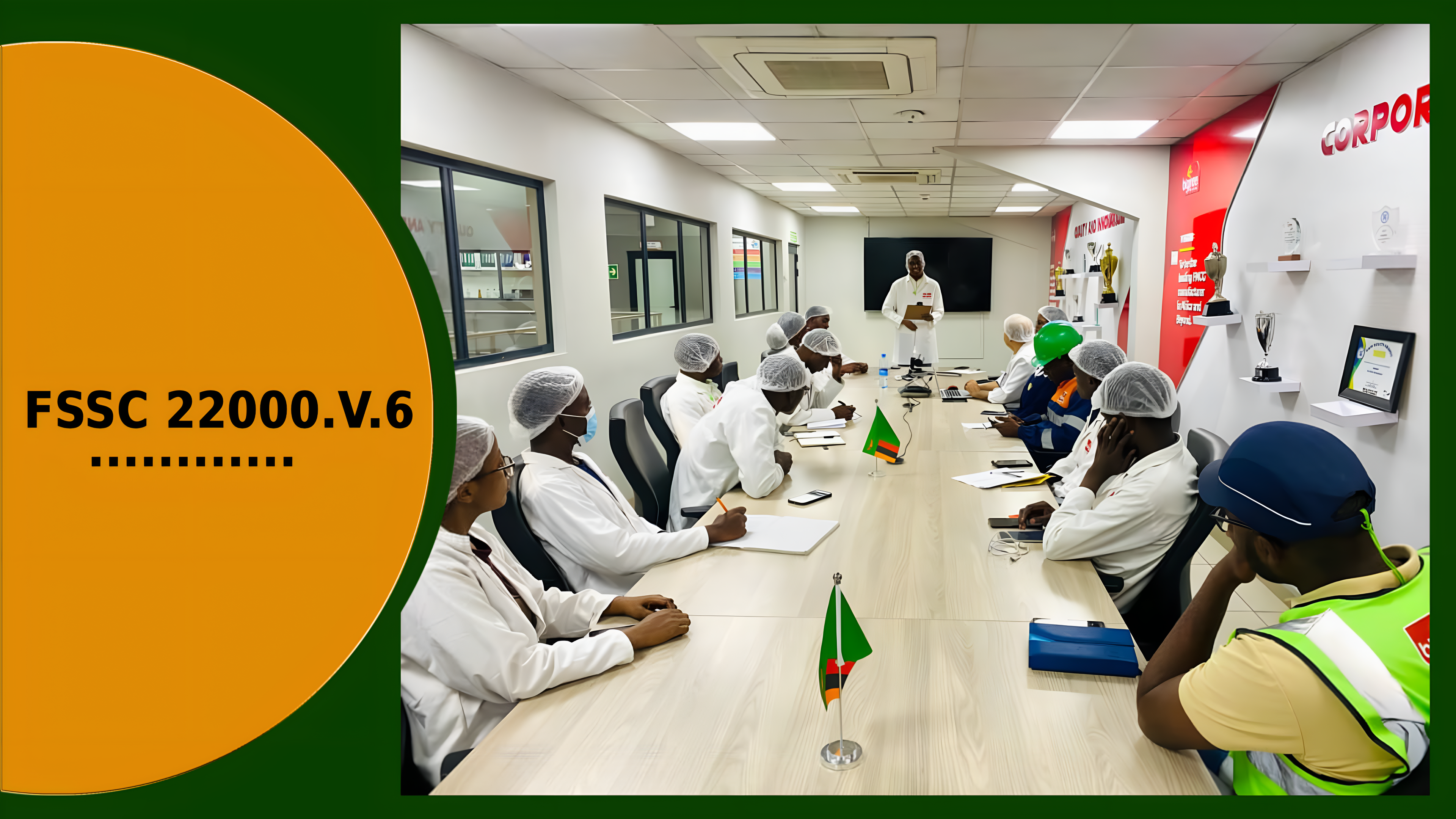
On 09 March 2026, an all-day FSSC 22000 Version 6 training was held at Bigtree Beverages MFEZ, Lusaka, facilitated by Intertek — a globally accredited Total Quality Assurance body. The training was organised by the QA Department and targeted new employees and selected staff who had not attended a previous session. This document is the official summary authored by the Quality Assurance Officer following the training.
What is FSSC 22000?
FSSC 22000 stands for Food Safety System Certification 22000. It is a globally recognised, scheme-based certification standard providing a comprehensive framework for managing food safety risks across the food supply chain. The number series "22000" is assigned to food safety by the ISO (International Organisation for Standardisation).
Key ISO Standards
| Standard | Scope |
|---|---|
| ISO 9001 | Quality Management Systems |
| ISO 14001 | Environmental Management Systems |
| ISO 22000 | Food Safety Management Systems (first published 2005) |
| OHSAS 18001 | Occupational Health and Safety Management Systems |
History
The formal development of food safety management principles can be traced back to the 1960s, when NASA (National Aeronautics and Space Administration) faced the critical challenge of producing, processing, and storing food for astronauts on space programmes. The food had to be safe, free from pathogens, and have an extended shelf life under conditions that made conventional quality inspection impractical. This initiative gave rise to what eventually evolved into the HACCP system — the scientific cornerstone of modern food safety management.
Components of FSSC 22000 — Version 6
FSSC 22000 Version 6 is built on three interlocking components:
- ISO/TS 22002-1: PRPs for food manufacturing
- ISO/TS 22002-3: PRPs for farming (including egg production)
- NEN/NTA 8059: PRPs for food brokers and agents
- BSI/PAS 221: PRPs for retail (British Standards Institution)
Version 5.1 — QMS Module
Version 5.1 introduced an optional QMS (Quality Management System) module integrating ISO 9001 (quality management) with ISO 22000 (food safety management) into a unified, auditable system framework.
The Food Chain
In the food production industry, the food chain refers to the complete sequence of interconnected stages and operations involved in the production, processing, distribution, storage, and consumption of food — from primary farming and raw materials all the way through to the end consumer. Effective food safety management must be applied across the entire chain.
Food Chain Categories
| Category | Description |
|---|---|
| A-I / A-II | Farming of animals - livestock and aquaculture |
| C-I to C-IV | Food manufacturing - various subcategories of processing |
| D-I / D-IIa / D-IIb | Production of animal feed and pet food |
| E | Catering and food service |
| F | Retail and wholesale trade |
| G | Transport and storage |
| I | Food packaging and packaging materials production |
| K | Production of (bio)chemicals used in food production |
PDCA Cycle ⇾ Execution Framework
PDCA (Plan–Do–Check–Act) is the operational methodology for implementing and improving the FSSC 22000 system:
Plan
Identify objectives, hazards, risks, and define control measures.
Do
Implement the planned processes, PRPs, and HACCP controls.
Check
Monitor, measure, and verify that controls are effective.
Act
Take corrective action and drive continual improvement.
Additional Requirements - FSSC 22000 V6
The following are mandatory for FSSC 22000 certification, on top of ISO 22000 and the relevant ISO/TS 22002 series:
HACCP ⇾ Hazard Analysis and Critical Control Points
HACCP is a systematic, science-based approach to identifying, evaluating, and controlling food safety hazards in the food production process. It is a preventive system specifically addressing unintentional (naturally occurring or accidental) hazards within the processing environment.
The 7 Principles of HACCP
Identify and evaluate all biological, chemical, physical, and allergenic hazards at each process step.
Identify steps where control is essential to prevent, eliminate, or reduce a hazard to an acceptable level.
Define the maximum and/or minimum values that must be controlled at each CCP.
Define how each CCP will be monitored: method, frequency, and responsible person.
Define actions to be taken when monitoring indicates a CCP is not under control.
Confirm the HACCP system is working effectively through audits, testing, and review of CCP records.
Maintain all HACCP records and conduct regular reviews and updates of the system.
Types of Hazards
| Type | Examples |
|---|---|
| Physical | Glass fragments, metal shards, plastic pieces, stones, wood splinters |
| Chemical | Lubricants, cleaning/sanitising chemicals, pesticide residues, chemical spills |
| Biological | Pathogenic bacteria (Salmonella, Listeria, E. coli), moulds, yeasts, viruses |
| Allergenic | Milk, eggs, fish, peanuts, tree nuts, wheat, soy — any ingredient causing adverse immunological reactions |
TACCP - Threat Assessment and Critical Control Points
TACCP is a systematic methodology used to identify, assess, and manage threats arising from intentional acts targeting the food supply chain. Unlike HACCP, TACCP focuses on deliberate attacks motivated by malicious intent — product tampering, sabotage, extortion, or terrorism.
Industry Example
A beverage manufacturer identifies that its open-top blending tanks - accessible to all production-area staff - represent a high-threat point for intentional contamination. The TACCP assessment results in locked tank covers, restricted access controls, and CCTV monitoring of the blending area as targeted control measures.
VACCP - Vulnerability Assessment and Critical Control Points
VACCP is a systematic process used to identify and manage vulnerabilities in the food supply chain exploitable for food fraud — the deliberate adulteration, substitution, dilution, mislabelling, or misrepresentation of food for economic gain.
Key Components
- Supply Chain Mapping ⇾ Identification of all ingredients and their supply chains.
- Vulnerability Scoring ⇾ Each material scored on economic motivation for fraud, accessibility, historical incidents, and detectability.
- Prioritisation ⇾ High-risk materials escalated for enhanced controls: supplier audits, certificates of analysis, independent testing.
- Food Fraud Mitigation Plan ⇾ Documented controls with defined ownership and review frequency.
Industry Example
A juice manufacturer sources concentrated fruit juice from multiple international suppliers. The VACCP assessment identifies this as high-risk for economic adulteration (e.g., dilution with cheaper juice or addition of undisclosed sugars). Controls implemented: mandatory third-party isotopic testing per batch and annual unannounced supplier audits.
A Question to Reflect On
Esiah Kapinga
QA Officer - Bigtree Beverages Limited

A supplier produces raw mango pulp or puree — no added sugar, no external material whatsoever. Pure, unadulterated product on their side. They document it, they trust their process, and they dispatch it.
On the receiving end, the plant conducts intermediate analysis and detects an abnormally high Brix reading — a figure that should not be achievable from raw mango pulp alone. The suspicion of sugar adulteration is raised. A formal complaint or case is filed against the supplier.
Here is the problem: the supplier cannot afford to lose this. Not financially - but in terms of reputation and market standing. They maintain they did nothing wrong, and on their side, they genuinely may not have. But the evidence at the receiving plant points in one direction.
Given that VACCP is designed to assess and respond to food fraud vulnerabilities - how do you justify an intentional fraud finding against a supplier when the point of compromise cannot be conclusively located? And whose burden of proof is it when the breach may have occurred anywhere between production and receipt?
About Intertek
Intertek is a leading Total Quality Assurance provider operating in more than 100 countries worldwide. The organisation delivers testing, inspection, certification, and auditing services across the food and beverage, consumer products, chemicals, and manufacturing sectors. In the food industry, Intertek provides FSSC 22000, ISO 22000, BRC, and other food safety certification and training services. The FSSC 22000 Version 6 training at Bigtree Beverages MFEZ on 09 March 2026 was facilitated by Intertek as an accredited certification and training body.
Download the Full Training Summary
The complete FSSC 22000 Version 6 training summary is available as a formatted PDF document.
📄 Download PDF ← Back to Experience